|
You read that right. For the first time in decades there are more jobs available than the actual number of people that are on unemployment. As of July 2018 there are 6.3 million people in the US on unemployed, the equivalent of 3.9%. Axios, an online media company, shared yesterday we’ve officially crossed the barrier of more jobs available than people suitable or ready to fill them. Our economy also continues to boom as we’re in the longest job growth period on record, now 94 straight months. 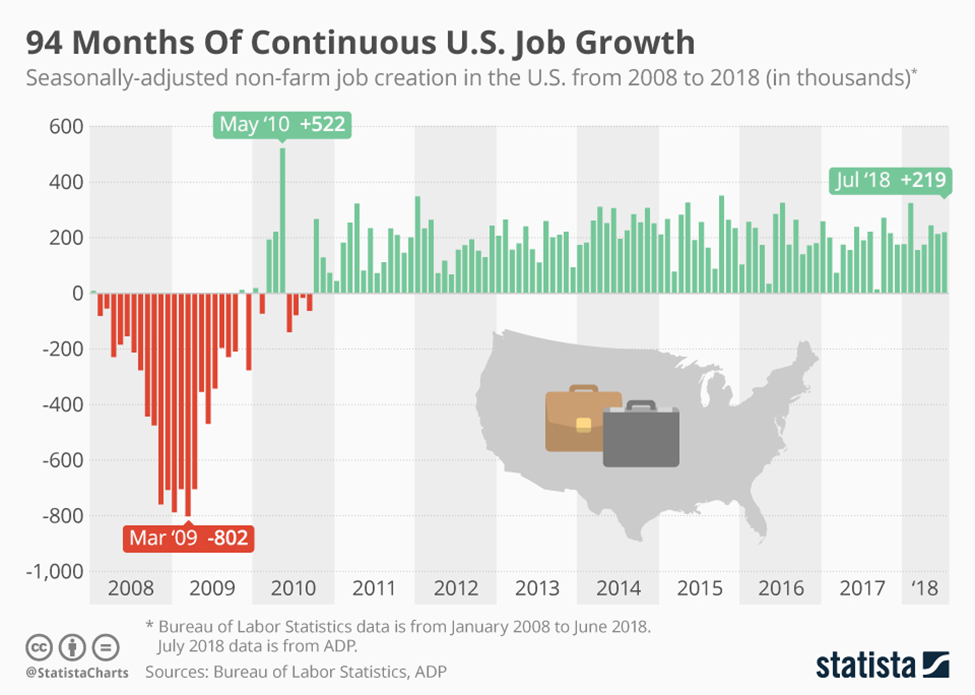 How can this be? If the economy is doing so well and there are so many jobs available why is it we still have so many people unemployed and why aren’t those which are unemployed taking the available jobs? ANSWER: The American workforce is changing, changing in TWO BIG WAYS: 1. Sedentary Lifestyle: we’ve become a society of professional sitters. The average person now sits, yes – sits on their keister, upwards of 51 hours and 44 minutes a week. It’s such a dramatic change in our society and workforce that some are now calling ‘sitting’ the new cigarettes. We’ll leave the health aspect of sitting to another article. For younger generations this lifestyle is their only perspective on working and it’s beginning to have a significant impact on our economy as it’s changing the jobs they’re taking, or willing to consider. Jobs which are considered physically or mentally demanding aren’t at the top of the pecking order and those industries are having an incredibly difficult time getting new blood to join the ranks. (construction; farming; trucking; skilled trades like plumbers, electricians, mechanics; emergency services; law enforcement, etc.) The change to a seated society tells us something else. As a society we are moving away from a ‘do-it-yourself hands on’ society where we’re focused on production to a society of ‘creative typists’. The new skilled trade is programming, not plumbing. Today’s emerging workforce wants to be close to technology and feel good movements while being free of work which may be construed as physically or mentally taxing. Getting your hands dirty on the job is out, sitting inside with the AC and nap-pods is in! 2. The Skill-less Unemployable: No one likes to think that there are people out there which don’t have skills or aren’t employable, it’s un-American. Yet it is becoming an increasingly frightening reality. The second reason our workforce is changing is there are a growing number of unemployed workers that are finding themselves unable to take advantage of the volume of job opportunities on the market due to their skills or abilities becoming out dated. Out of date just like the baloney sandwich my mom used to make for my lunch in grade school. No one eats baloney sandwiches anymore, so if you didn’t adjust your skills with the growing times, moving to turkey or tofu, you got left behind. And left behind without even realizing it, holding a moldy, crappy sandwich (your skills) in the process. Those who are unemployed at present are largely in part just not employable. Of course, there is always the exception to this rule however the growing majority of people who are unemployed just don’t have current day marketable skills to function in an environment which increasingly demands technology proficiencies. With national unemployment rates under 4% it tells us that those who can work are working and those who can’t – well they’ll continue to experience hardships trying to find jobs in a marketplace that is increasingly unforgiving and more expecting of people’s capabilities. As a result, the gap continues to widen whereas those who have been unemployed for some time trying to find work will continue to experience much of the same. The stigma attached to unemployment, the longer you’ve been out of work the more likely it is you will remain out of work, is a harsh reality for those unemployed. With so much opportunity to be had in the marketplace people who are unemployed for longer than a month or so find themselves having to develop colorful explanations as to why they weren’t working to hopefully appease prospective employers.
0 Comments
 How do you know the decisions you make for your career are the right ones to make? On February 20th DeviceAlliance and UCI’s Division of Continuing Education will take aim at the in’s and out’s we face throughout our careers in an event called ‘Medical Device Career Navigation’. While we are all very different as people in our behaviors and our mindsets it’s remarkable how those differences bond us in similarity. Many of us will experience the same decisions throughout our career. Do we take the money or the training? Prestigious titles versus meaningful work? Take a step back to hopefully take two forward. Be my own boss or work for someone else? Stay the path of employee or seek opportunities in management? Or even leaving a career to begin anew. The answers to these questions are never easy yet we are all faced them! In this, a powerful opportunity exists - learning from those who have been there before. On the 20th of February in Irvine, CA the event ‘Medical Device Career Navigation’ will embark on a journey through the entire life cycle of a career from college graduate to retirement, and everything in between. Attendees will hear from experienced professionals who represent three career segments:
EVENT SPEAKERS 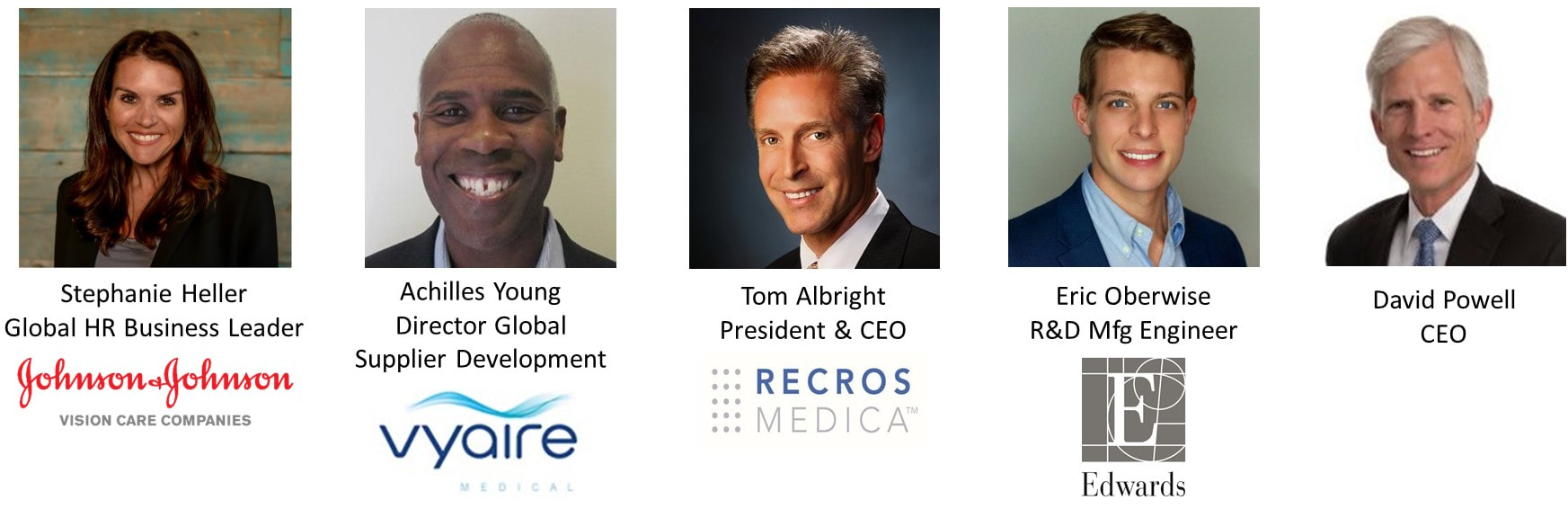 As we work our way through each career segment we will hear and learn first hand from professionals who have been there and done it before. We’ll discover the lessons they learned, decisions they made and outcomes they experienced along the way. We’ll learn from their stories and have opportunities to inquire about our own situations to collect feedback and direction. During this event we will also discuss structured processes for decision making, like ACIP. ACIP, or Alternatives, Consequences, Information and Plans, is a process for collecting information and understanding our options BEFORE we make a decision. Utilizing processes like ACIP and others which are similar can help improve your decision making process. Combine that with experienced anecdotes from people who have done it themselves and we have a recipe for improving our chances of making the best decisions for ourselves while reducing regret or heartache along the way. Save the Date: Be sure to join DeviceAlliance and UCI’s Division of Continuing Education on February 20th, 2018 at 5:30PM for an evening of learning and discussion on ‘Medical Device Career Navigation’. Event details and RSVP click HERE.  Last week a friend and I had an interesting conversation over dinner having to do with hiring new grads from college. The two of us agreed that we have seen a rise over recent years with the number of people coming out of college ill-prepared for the working world. But why? We discussed the disparity that exists with some new grads and their ability to actually put their years of scholastic achievement to work in the real world. Regardless of their GPA many of them struggle and it has employers concerned, especially in the engineering world. This is where our conversation hit a crucial point and where the rubber meets the road for our recent college graduates: theory versus application. In academia theory is served up on a silver platter. Students learn by lecture, book and lab. They learn the ideal setting and framework of hundreds of concepts. What they learn is ‘HOW’ something works, where it comes from and should you need to replicate it follow these guidelines, etc. Kind of like a recipe for baking a cake. Follow these instructions and the result will be a nice red velvet cake. My favorite! Unfortunately what we get a lot of times after the supposed recipe has been followed by new grads is not red velvet cake at all. It’s a pile of crap that doesn’t remotely resemble a cake nor is it edible. Simply being able to follow a recipe, or recite a definition for that matter, does not mean you truly understand the concept which can be a really rude awakening for a newly hired recent graduate in the working world. Our recent engineering grads may be able to tell us the definition of Ohms Law, reciting it verbatim however they struggle to actually use that same theory in practice in the working world when it actually counts. What academia fails to accomplish is teaching and engraining in its students heads the ‘WHY’ part of the recipe, not just the ‘How’. Learning the ‘WHY’ behind a concept provides us with a larger frame of understanding rather than just surface level information. This articulates the important difference between information and knowledge. (information = theory whereas knowledge = application) When we know why something exists we can better apply said concept to real world settings and or make suitable adjustments when things go array. The ‘WHY’ piece also addresses creativity. When we’re confronted with an issue or challenge in the working world there’s no professor or recipe to help keep us on track. No directions that say ‘substitute this for that if this happens’. One has to be able to draw on their creative juices AND theory to come up with possible solutions. Why do recent grads struggle with applying their education in the workplace? My humble opinion falls on two primary contributors:
Don’t worry employers. Fret not new grads, we can fix this challenge so that everyone comes out on top. How can we change this to help our new grads?
 Last week I had the honor of moderating a speaking engagement put on by Device Alliance in Irvine, CA. If you aren’t familiar with Device Alliance (DA) it’s a Medical Device industry association whose primary focus is providing a supportive platform for the continued knowledge development and relationship building within the medical device industry in SoCal. The purpose of the event on July 20th was simple – to have an informative discussion on ‘Changing Workforce Dynamics’ surrounding these three topics:
 As we got into the meat of the content for the evening I started to pick up on a topic that seemed like it was trending in a fair amount of our conversation.
Is the Medical Device industry attracting younger generations at the rate it should? There seemed to be a fair amount of dialogue and a bit of concern from some people present at the event addressing a discrepancy within the industry as it seemed that new grads weren’t flocking to medical devices like they once had. I can’t substantiate this claim to say ‘yes’ it’s happening, or ‘no’ it isn’t, however it’s a powerful topic to discuss because it’s a potential challenge we face in the near term if in fact it is true. So let’s hypothesize for a moment: If new talent, in particular younger generations, are not entering the medical device industry like they used too, what are the potential cause and effects we’re faced with? CAUSES:
EFFECT:
Is the Medical Device industry attracting younger generations? What are you thoughts? Agree or disagree? Graduating from college is a great life accomplishment. You’ve worked hard for years and now have the chance to finally put your knowledge to the test along with your wonderful self out there for the professional world to enjoy.
As the college parties and farewells subside new college grads inevitably come face to face with a sobering reality... ...the fact that finding their first career job isn’t easy!Ideally, students should start focusing on their careers and entrance into their industry of choosing in their junior year of college, but more than likely you’ve waited till the very last day of school to think about it. Regardless of the situation you are in as you start to look for work it’s important to head into the process of finding a job armed with the right mental attitude and a winning game plan. Before you start looking for a new job it’s important to understand how these common new grad thought processes below can hurt your chances of landing a job:
Now that you’ve got a good head on your shoulders and understand a bit more of how the professional workplace functions you’ll need to do the following:
About the AuthorTravis Smith is the founder and managing director of Square-1 Engineering, a medical device consulting firm, providing end to end engineering and compliance services. He successfully served the life sciences marketplace in SoCal for over 15 years and has been recognized as a ‘40 Under 40’ honoree by the Greater Irvine Chamber of Commerce as a top leader in Orange County, CA. Categories
All
Archives
July 2024
|
 RSS Feed
Visit Square-1's
|
|