Developing your own design standardsExplore how establishing standards for design improves efficiency, establishes consistency across your company, and saves time and money. Here’s a challenge I see quite often while we’re on a client project involving mechanical design or CAD work. Does this seem familiar? Someone is tasked with designing a new sub-assembly or component for an existing product. As they get underway their work on face value gets the company to a conclusion where the design/ drawing is technically complete. As such, this person is able to check off ‘task completed’ and move on to the next assignment. While the work may have technically been completed, it often is done in a fashion which causes all sorts of problems down the road for the company, including other employees working on the same project within the same organization as well as their external suppliers. How is it someone can complete a design project satisfactory on the surface, yet problems arise down the road with that very same design, which had been previously approved? The Devil in the Details:or lack thereof, to be more specific. Simply, companies or their respective employees experience this because they aren’t following a formal and documented standard for their product design practices, demonstrating a lack of discipline in design fundamentals (and perhaps training). As a result, employees are left to decide for themselves how to complete a task which may get them to the finish line, but the approach, process, and details along the way can have wild variances and interpretations. This may be commonplace and old news to many of you reading this article, but the reality is that the actual practice of designing a product with repeatable ‘gold standards’ is anything but common sense or consistent. When the approach to design is fast and loose, it is common to find that:
When these issues show up it causes companies to reinvest dollars and resources into their work in order to move the project forward to get it to a point of where it can be properly advanced along the product development life cycle. This reinvestment is unnecessary and a huge time suck. We see this a lot when a medical device OEM has a contract manufacturer (CM) do some of their design work. In more times than I can count the work which is produced in this scenario is rough, limited with detail and documentation, almost never parametrically driven, and close to useless in other scenarios. Don’t fall for the trap of “we just need drawings.” While that may be the case in the moment, this will almost always cause you more work and funds down the road. The Gold StandardFor these reasons it’s vital companies implement a ‘gold standard’ in their design work for their employees and suppliers to follow, ensuring consistency across in format, intent, and approach across every involved party. This unification of process increases the likelihood design work is done correctly, while also ensuring future usage of said designs don’t require unnecessary iterations or redesigns. If implementing a ‘gold standard’ for your design and product development practices could be a benefit to your team or company, here are some of the key points to consider:
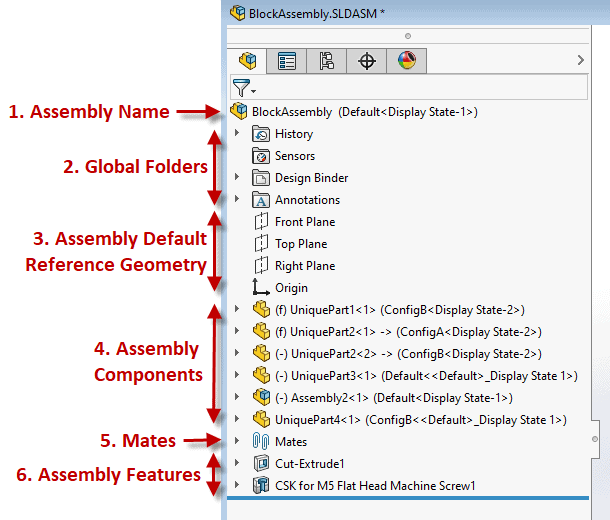
Example below: A well laid out Solidworks Assembly Feature Manager Design Tree If you, and or your company, lacks a ‘gold standard’ for your product design efforts you are inevitably wasting time and resources. This also has a direct correlation to a suppliers’ ability to help with outsourced work causing the overall project to be more challenging and lengthier than necessary (prototyping, manufacturing, etc.) While this isn’t a fun realization there is hope! Here’s how to fix it. Start right away by developing a best practice plan. This will help you and your team form an outline for what design practices and approaches are ideal for your product and technology, which aren’t, etc. From there setup a review plan to provide feedback on all work performed. Once the infrastructure of your new gold standard system is established you’ll want to asses the skills of your team and develop a training program which can be offered to both new and existing employees.
0 Comments
Leave a Reply. |
About the AuthorTravis Smith is the founder and managing director of Square-1 Engineering, a medical device consulting firm, providing end to end engineering and compliance services. He successfully served the life sciences marketplace in SoCal for over 15 years and has been recognized as a ‘40 Under 40’ honoree by the Greater Irvine Chamber of Commerce as a top leader in Orange County, CA. Archives
April 2026
March 2026
February 2026
January 2026
December 2025
October 2025
September 2025
August 2025
July 2025
June 2025
May 2025
April 2025
January 2025
October 2024
September 2024
August 2024
July 2024
May 2024
April 2024
March 2024
February 2024
January 2024
December 2023
November 2023
October 2023
September 2023
August 2023
July 2023
June 2023
May 2023
April 2023
March 2023
February 2023
January 2023
December 2022
November 2022
September 2022
August 2022
July 2022
June 2022
May 2022
April 2022
November 2021
October 2021
April 2021
March 2021
February 2021
January 2021
December 2020
November 2020
October 2020
September 2020
July 2020
June 2020
May 2020
April 2020
March 2020
December 2019
November 2019
October 2019
September 2019
August 2019
July 2019
June 2019
May 2019
April 2019
March 2019
February 2019
January 2019
December 2018
November 2018
October 2018
September 2018
August 2018
March 2018
February 2018
January 2018
June 2017
May 2017
April 2017
February 2017
December 2016
October 2016
September 2016
August 2016
July 2016
June 2016
May 2016
September 2015
|
RSS Feed